Hospital Core Lab Plan
Multi-instrument support with critical path escalation, spare parts review, reagent lot planning, and after-hours triage for chemistry, hematology, and immunoassay benches.
Hospitals, reference laboratories, specialty clinics, and multi-site health systems do not need the same service profile. Beckman Coulter separates coverage by instrument criticality, sample volume, LIS dependency, and the way your biomed team already works. The goal is to strengthen your internal team with predictable escalation, not replace institutional knowledge.
A service plan begins with installed base review, interface mapping, recall sweep responsibility, and parts risk. From there, the plan defines preventive maintenance windows, response expectations, remote support rules, and the documents your laboratory needs for CAP, CLIA, or internal quality audits.
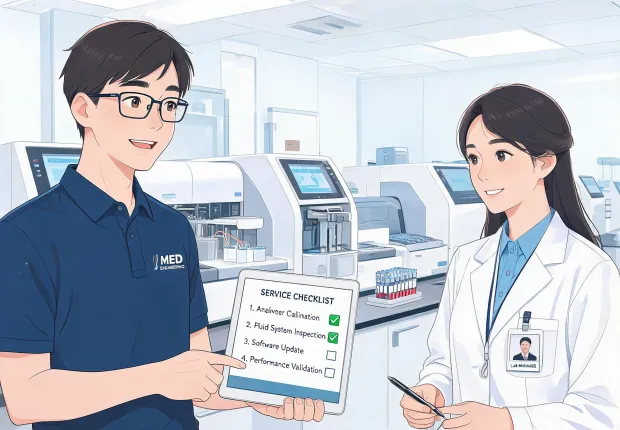
Multi-instrument support with critical path escalation, spare parts review, reagent lot planning, and after-hours triage for chemistry, hematology, and immunoassay benches.
High-volume service scheduling, uptime dashboards, preventive maintenance batching, interface change control, and throughput-focused risk review.
Compact analyzer support, operator retraining, calibration review, quality documentation refresh, and practical service windows around patient schedules.
Cross-site inventory visibility, standardized validation files, central contract governance, and recurring reviews with laboratory leadership and supply chain.
Tiered support that keeps local biomedical engineers in control while giving them direct escalation to application and field service specialists.
Installation calendar, LIS test scripts, operator competency tracking, QC baseline review, and a post-launch stabilization check after first patient result reporting.
We augment the in-house team. Your staff keeps routine ownership and facility context, while Beckman Coulter provides escalation, application expertise, documentation review, and parts planning when the issue crosses into analyzer-specific risk.
Covered sites can receive UDI-oriented recall sweeps, impact summaries, and correction tracking. The service plan defines which department receives the first notice and how completion evidence is filed for audit review.
Yes. Service work can be coordinated with common CMMS systems, while LIS planning reviews HL7, ASTM, middleware, and local validation requirements before go-live or interface changes.
Remote sessions are handled with facility authorization, limited purpose access, and privacy-aware logging. If protected health information may be visible, the workflow follows the required business associate or data processing terms defined by the customer.
Include current analyzer families, average daily samples, LIS or middleware platform, desired response window, and any open validation or audit deadline. A practical plan should help operations, quality, and procurement use the same facts.